Distributed Multi-Robot Ergodic Coverage Control for Estimating Time-Varying Spatial Processes
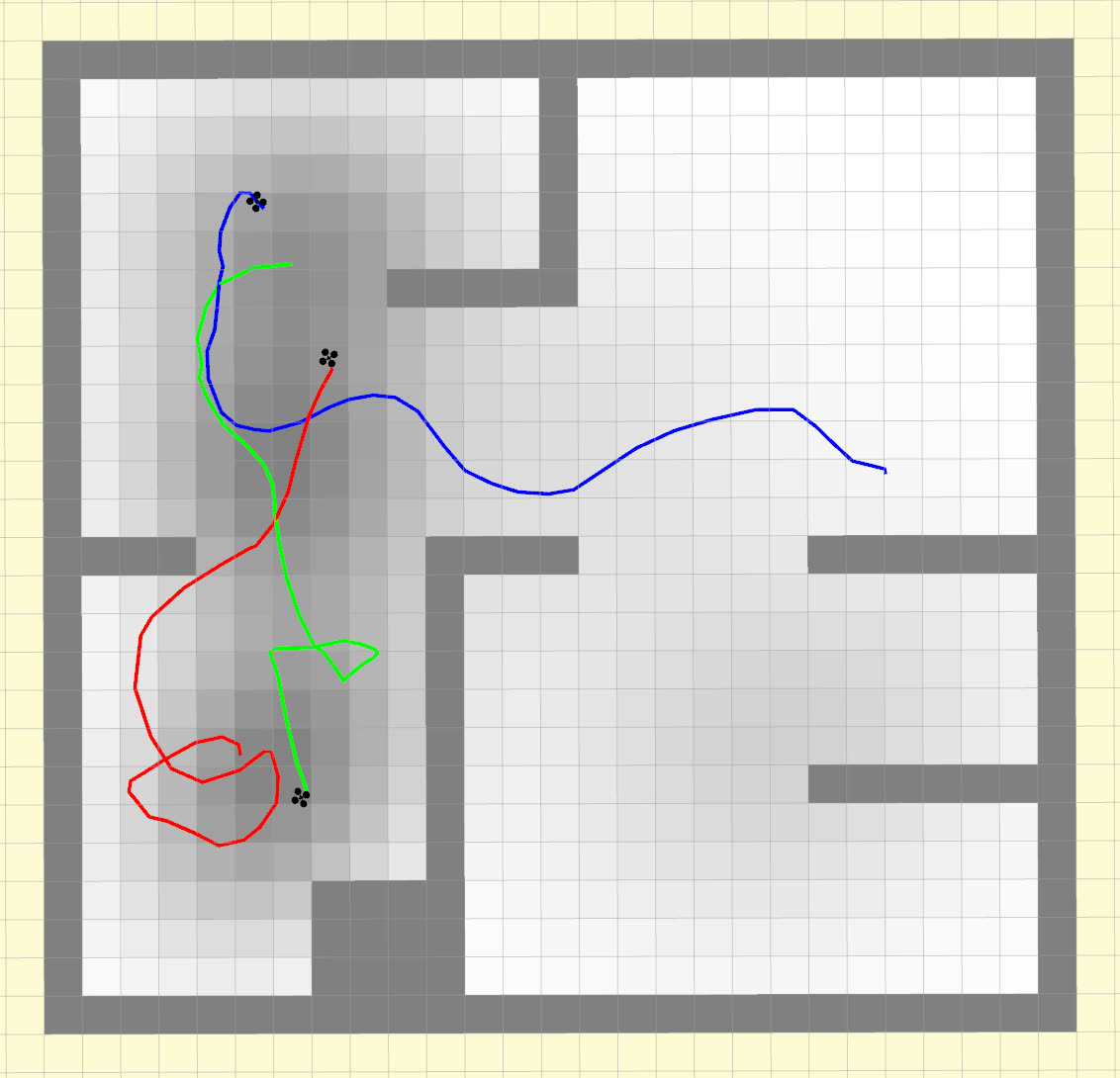
The team keeps exploring and re-covers a target that suddenly moves, while the centralized HEDAC baseline keeps covering the old location. Flown fully onboard on three drones.
Problem
A robot team has to monitor a spatial process (temperature, gas concentration, a detection likelihood) that is unknown and changes over time. Each robot senses through a narrow field of view and talks only to neighbours in range, the map is cluttered and non-convex, and there is no central coordinator. The team must explore, learn the field and keep covering the regions that matter, without colliding.
Approach
- Each robot learns the field online with a time-varying Gaussian Process; old samples decay, so the team keeps re-visiting.
- Robots exchange only poses and a few informative samples with neighbours in range.
- A dynamic goal density sums the GP mean and its uncertainty: explore where unsure, monitor where the field is high.
- A heat-equation (HEDAC) potential field turns that density into velocity commands, handles obstacles and keeps a minimum separation.
What we did
- Distributed ergodic coverage framework with a new dynamic goal density and a temporal decay mechanism.
- Local stability analysis for instantaneous changes of the process.
- Simulations with four robots on a static field and on a field that abruptly jumps location, against the centralized HEDAC oracle.
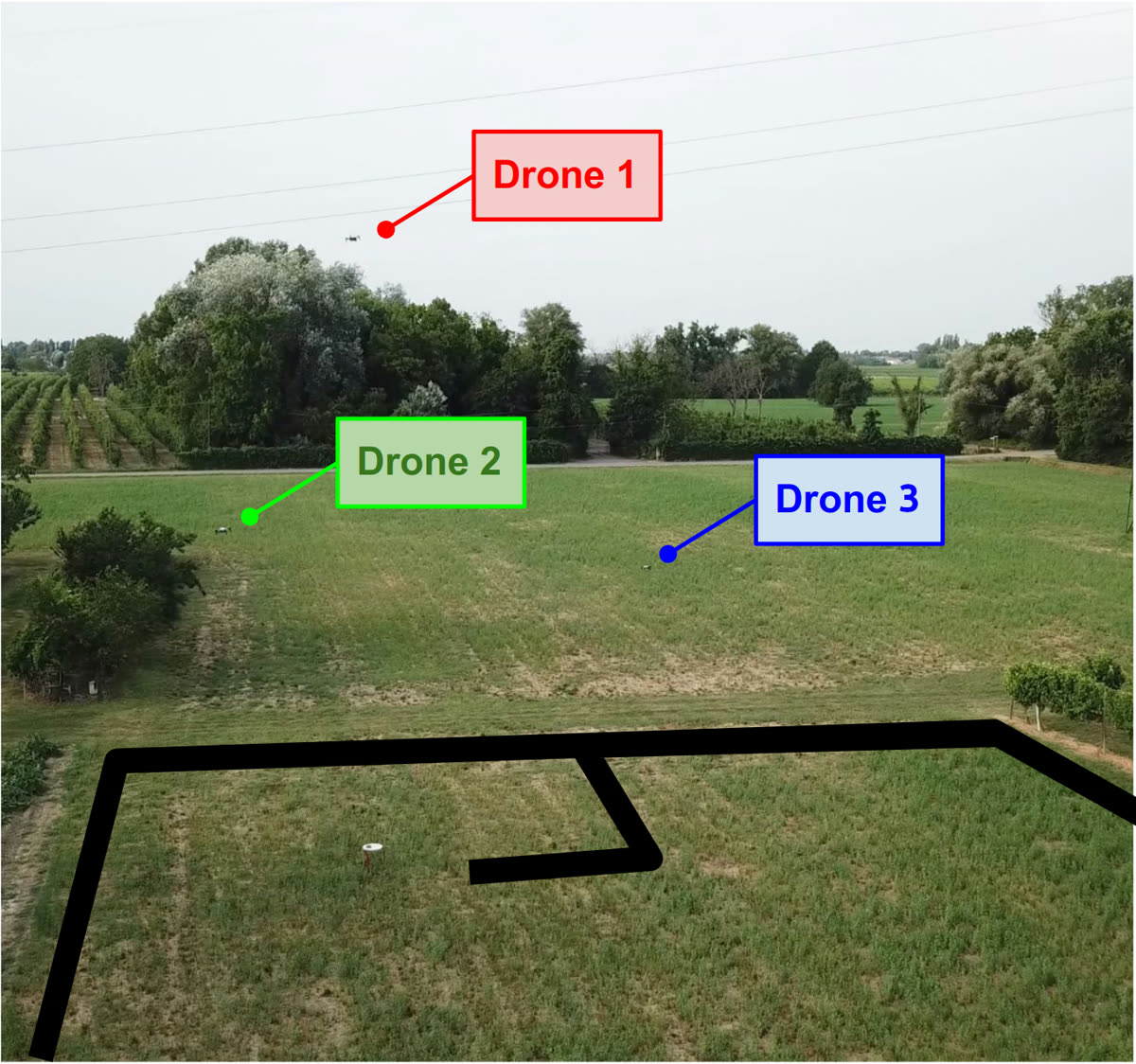
- Field flights with three Uvify IFO-S drones running the whole algorithm onboard.
Results
- Static field: the team keeps an explore-cover-repeat cycle instead of converging to the key area and stopping, as the baseline does.
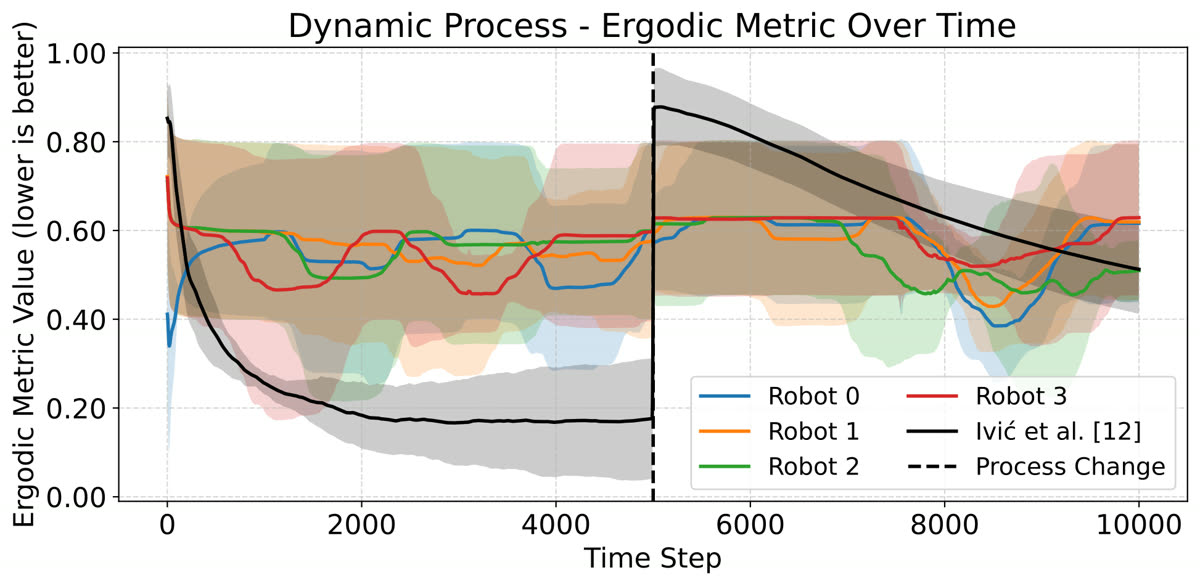
- Moving field: when the process jumps at step 5000, the ergodic metric stays stable and the team re-targets; the centralized baseline starts lower, jumps from ~0.18 to ~0.88, and needs ~4000 steps to come back to the team’s level.
- Real flights: robust to GPS inaccuracy, IMU drift, latency and WiFi packet loss, thanks to low-bandwidth, neighbour-only communication.
Stack
- Drones
- 3× Uvify IFO-S
- Flight control
- PX4, fed velocity setpoints by the ergodic controller
- Onboard compute
- NVIDIA Jetson Nano 4 GB, full algorithm onboard
- Middleware
- ROS 1 nodes over WiFi, neighbour-only messages
- Ground station
- roscore + QGroundControl, supervision and logging only