Learning while covering: distributed Gaussian Process coverage control
RA-L 2024: noisy sensors →ICRA 2025: federated learning →T-RO 2025: time-varying fields →
A robot team learns an unknown field from noisy sensors, keeps its model small enough to run on every robot, and re-deploys when the field moves, with no central computer. Up to 74% less compute per robot; verified on real TurtleBot3 teams.
Problem
Voronoi coverage assumes every robot already knows where the interesting regions are. In practice the field (a gas plume, a temperature, a detection likelihood) is unknown, noisy and changes over time. Robots sense only nearby and talk only to neighbours, and a Gaussian Process gets cubically slower with every sample it keeps. The team has to learn the field and cover it at the same time.
Approach
- Each robot owns a limited Voronoi cell and moves to its density-weighted centroid: the coverage controller from our earlier work.
- The density is a GP upper confidence bound, σ + W·μ. Unsure regions pull the team to explore, known peaks pull it to cover.
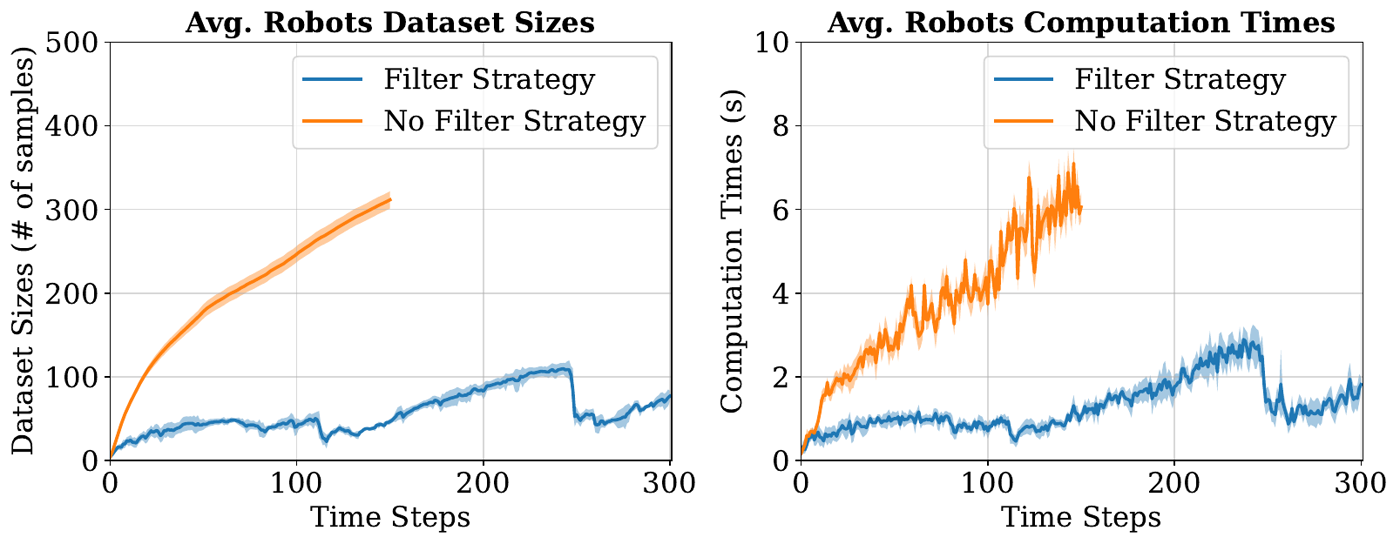
- A filter keeps a sample only if the GP is still unsure there, so the dataset and the O(N³) cost stay bounded.
Three papers, one line of work
- RA-L 2024, first author. Static field, noisy sensors. An exploration–exploitation weight that grows over time, and a variance-based filter that also handles sensor noise. Robots share only filtered samples.
- ICRA 2025, first author. Federated learning: the team trains one GP together (ADMM on the hyperparameters, consensus on the predictions) without ever sharing datasets. A second, eigen-decomposition filter keeps the training set small as data accumulates.
- T-RO 2025, second author, with F. Pratissoli. Time-varying fields. Samples age with an exponential decay, so uncertainty grows where nobody looked recently and the team re-explores by itself.
Results
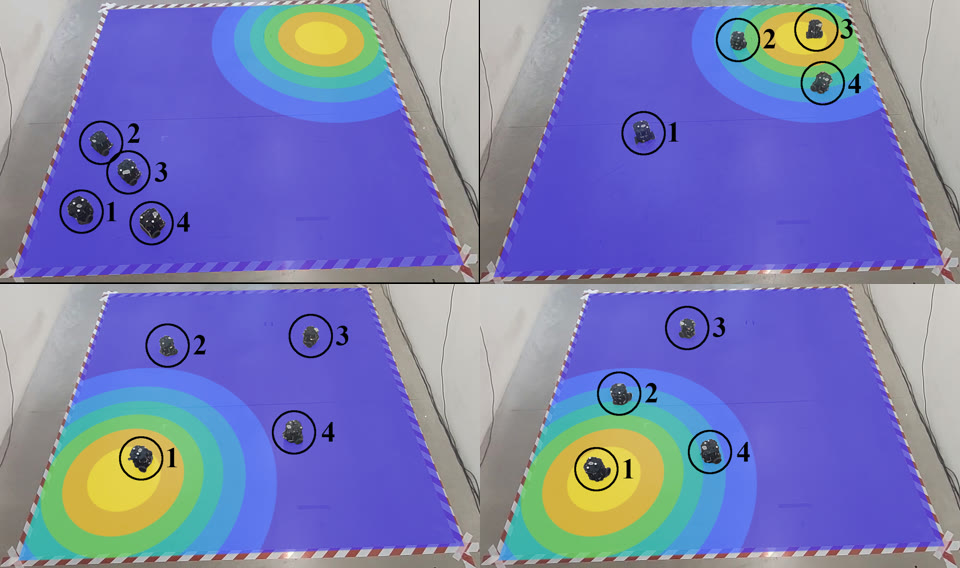
- RA-L: estimate error falls and the dataset stabilises while coverage stays close to an oracle that knows the field. A TurtleBot3 team finds and surrounds the peak in 100 s.
- ICRA: 72.85% fewer samples used in federated training, with simulated teams of 6 to 24 robots on real sea-surface-temperature data. Without the filter, hyperparameter learning fails and computation becomes intractable.
- T-RO: up to 68.5% smaller datasets and up to 74.3% less compute per robot (6 robots, simulation). Beats random exploration, plain coverage, a GP-coverage baseline and an adaptive path planner. On real robots the team re-converges after the field jumps mid-run.

Stack
- Robots
- 4× TurtleBot3 Burger (real runs), 5 simulated Mavic 2 Pro drones in Webots
- Control
- Limited Voronoi cells, centroid control; feedback linearisation for the differential-drive robots
- Estimation
- GP regression, squared-exponential kernel; time-decay kernel (T-RO); ADMM and average consensus (ICRA)
- Data
- Sea-surface temperature (ICRA), random Gaussian mixtures (RA-L, T-RO)
- Compute
- Python; timings on an AMD Ryzen 5 5600U laptop
The cover animation is a small illustrative simulation of the method, not experimental data.